Namely to BambooHR: The Mid-Market HRIS Migration Guide
As mid-market companies evolve, their Human Resources Information System (HRIS) requirements often shift from needing complex, highly customisable platforms to seeking intuitive, user-friendly systems that drive high employee adoption.
Namely has historically served companies needing deep customisation and built-in payroll. However, many organisations find its interface complex for everyday users. BambooHR, conversely, is celebrated for its exceptional user experience, straightforward reporting, and focus on company culture—though it often requires third-party integrations for complex payroll processing.
Switching from Namely to BambooHR is not just a data transfer; it is a fundamental shift in how your HR team operates and how employees interact with HR services. This guide details the technical and operational steps required to execute this migration without losing historical data, breaking payroll cycles, or frustrating your workforce.
Key Takeaways
- Data Mapping is Critical: Namely's highly customisable field structure requires meticulous mapping to fit into BambooHR's more standardized architecture.
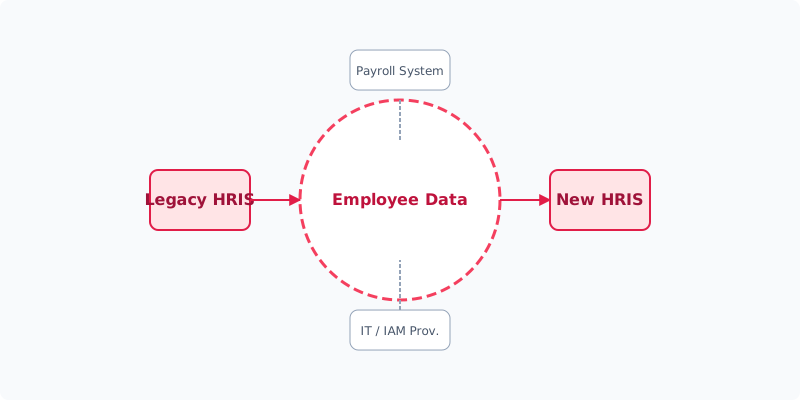
- Payroll Strategy: If you use Namely Payroll, you must transition to a new payroll provider (like Gusto or ADP) that integrates with BambooHR concurrently.
- Historical Data Limits: Decide early how much historical performance and compensation data you will migrate vs. archive. Migrating everything is often a mistake.
- Employee Communication: The success of the new HRIS depends entirely on employee adoption. Pre-launch communication is as important as the data migration.
Table of Contents
- Why Companies Make the Switch
- The Payroll Integration Dilemma
- Pre-Migration Data Cleanup
- The Step-by-Step Migration Process
- Common Pitfalls & Data Traps
- Cost Breakdown & TCO
- Frequently Asked Questions
Why Companies Make the Switch
Mid-sized organisations typically migrate from Namely to BambooHR to solve specific operational pain points:
1. User Interface and Adoption
BambooHR's primary competitive advantage is its UI. If your employees refuse to use Namely to request time off or update their personal details because it feels clunky, your HR team ends up doing manual data entry. BambooHR's intuitive design drastically increases self-service adoption.
2. Implementation of Performance Management
While Namely offers performance modules, BambooHR’s approach to performance management (focusing on frequent, brief assessments rather than annual reviews) aligns better with modern agile HR practices and is significantly easier to administer.
3. Reporting Simplicity
Namely allows for complex custom reporting, but it often requires HR ops specialists to build them. BambooHR provides clean, accessible, out-of-the-box reporting that HR managers and executives can pull immediately without technical assistance.
The Payroll Integration Dilemma (Connecting vs Switching)
The biggest hurdle in this migration is payroll. Namely operates as an "All-in-One" system offering its own managed payroll service. BambooHR partners with third-party payroll providers (like TraxPayroll, which they own, or integrations with ADP, Gusto, etc.).
You cannot simply "switch" HR systems if you use Namely Payroll; you must execute a concurrent Payroll implementation.
The API Connection Strategy: If you are moving to BambooHR for HR management but have selected a separate vendor for payroll, you must rely heavily on API integrations. BambooHR will act as your "System of Record" (where employee data is entered). You will need to ensure a bulletproof API sync is established so that when a salary changes in BambooHR, it instantly updates the new payroll system before the next pay run.
We may earn a commission if you sign up through this link.
Pre-Migration Data Cleanup
Migrating bad data into a new system ensures the new system will fail. You must clean your Namely instance before exporting.
- De-duplicate Records: Ensure there are no duplicate employee profiles (especially for re-hires).
- Standardise Job Titles: Use this opportunity to clean up title bloat. Map every employee to a standardized company job architecture.
- Audit Reporting Lines: Ensure every active employee has a correct, active manager assigned. Broken reporting lines will destroy approval workflows in BambooHR.
- Golden Copy Backup: Export ALL data from Namely (including terminated employees, documents, and historical compensation) and store it securely. You are legally required to retain certain HR records for years.
The Step-by-Step Migration Process
Phase 1: Architecture and Field Mapping
BambooHR has standard fields (First Name, Last Name, Salary). Namely likely has custom fields you created over the years. You must create a mapping spreadsheet. If Namely has a custom field for "T-Shirt Size", you must create that custom field in BambooHR before you import data.
Phase 2: The Core Import
Start with basic demographic and job data. Import your employees via BambooHR's mass import tool. Verify that reporting lines, departments, and basic compensation have populated correctly.
Phase 3: Time-Off Balances
This is highly sensitive. You must freeze time-off requests in Namely on a Friday, export the exact balances, and import them into BambooHR over the weekend. Ensure BambooHR's accrual policies are configured to match your company handbook exactly before doing this.
Phase 4: Document Migration
Exporting documents (offer letters, tax forms) from Namely and bulk-uploading them to specific employee folders in BambooHR often requires a custom API script or paying for implementation services.
Phase 5: Parallel Payroll Run
If you are switching payroll providers concurrently, you must run at least one (ideally two) parallel payrolls. Calculate payroll in Namely, calculate it in your new system (fed by BambooHR), and compare the gross-to-net reports. Do not cut over until variances are zero.
Common Pitfalls & Data Traps
- Migrating Too Much History: Do not try to migrate every performance review from the last 5 years into BambooHR's native performance module. It rarely maps cleanly. Keep historical reviews in a secure PDF archive and start fresh in BambooHR.
- The Re-hire Trap: Check how both systems handle employees who left and returned. If not mapped correctly, you will overwrite their original tenure data.
- Approval Workflow Breakages: BambooHR routes approvals based on the manager hierarchy. If the CEO does not have a manager, ensure the system knows how to handle their time-off requests, or the workflow will break.
Cost Breakdown & TCO (Total Cost of Ownership)
| Cost Component | Typical Scenario |
|---|---|
| BambooHR Licensing | Usually lower per-employee-per-month (PEPM) than Namely, but excludes payroll. |
| New Payroll Licensing | Additional cost (e.g., ADP or Gusto fees). |
| Implementation Fees | £2,000 - £8,000 (BambooHR or third-party partner). |
| Data Extraction | If you require Namely to provide a custom database dump, they may charge a fee. |
Overall, the TCO may remain similar, but the value is realized through reduced HR administrative hours and higher employee satisfaction.
Frequently Asked Questions
Can I do this migration myself? If you have fewer than 50 employees and simple HR needs, yes. If you have 200+ employees, complex accrual policies, and are switching payroll, you should hire an implementation partner.
What happens to former employees? You can import them into BambooHR as "Terminated" employees so you retain their basic demographic and employment dates for compliance reporting.
How long does the implementation take? A safe timeline for a mid-market company (100-500 employees) is 8 to 12 weeks, largely dictated by the payroll parallel testing schedule.